Jacopo Grilli
György Barabás
Matt Michalska-Smith
Stefano Allesina
Acknowledgements

Jacopo Grilli

Gyuri Barabás
Stefano Allesina
| E. L. Sander C. A. Marcelo Serván D. Maynard E. Leigh J. Aljadeff |
A. Monteiro J.A. Capitán F. Brandl J.M. Levine J-F. Laslier |




JEROME VALLETTE/AFP/Getty Images
Nacho Doce/Reuters
Model Assumptions




$$\sum_i x_i = 1$$
Building a Model
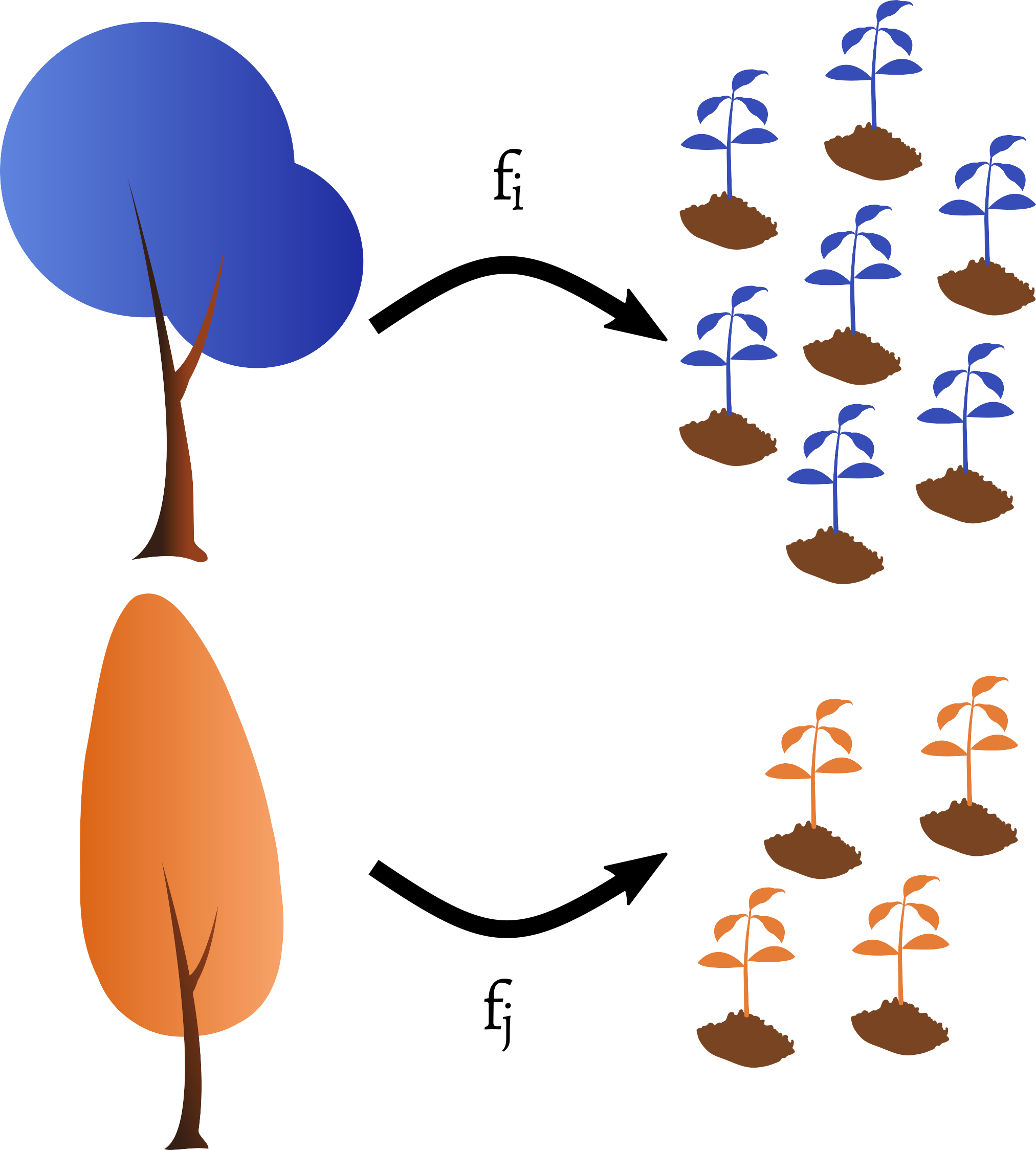
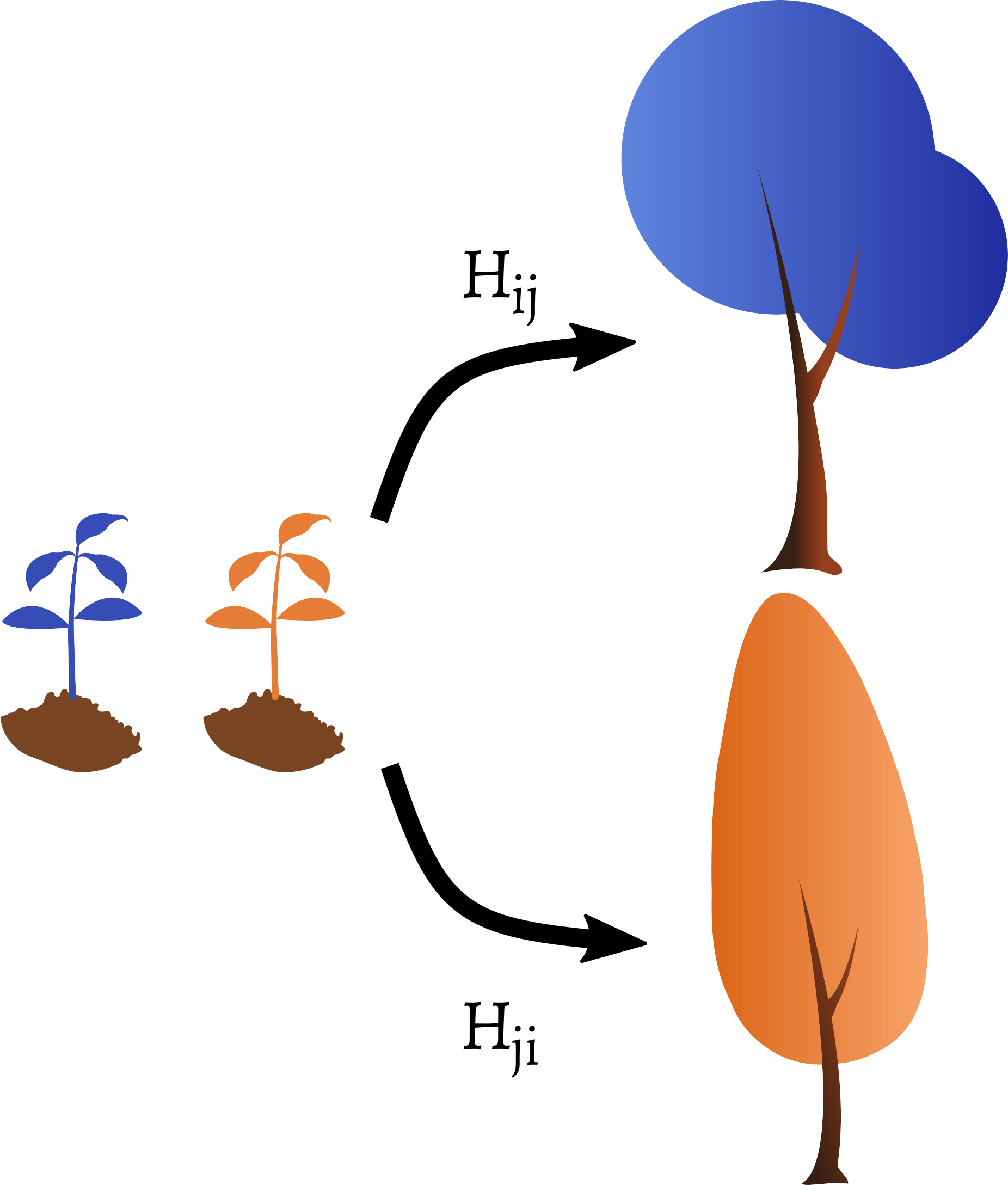
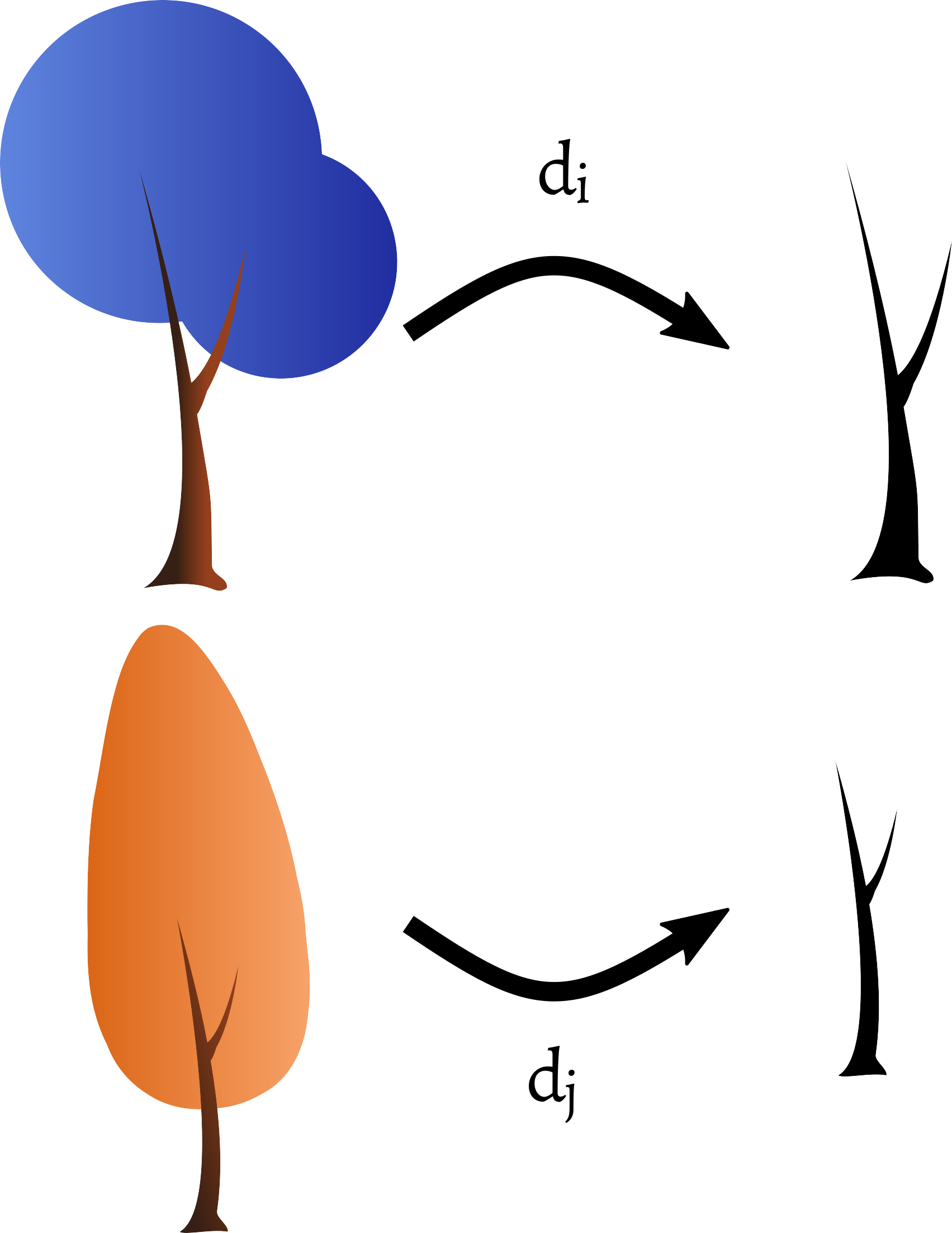
$$\propto f_i x_i$$
$$\begin{align}\mathcal{P}(i \text{ wins against } j) &= H_{ij}\\ &= 1 - H_{ji}\end{align}$$
$$d_i x_i$$
Relation to Prior Models
- Neutral Theory of Biodiversity (Hubbell 2001)
- $$f_i = d_i = 1 \text{, } H_{ij} = H_{ji} = 0.5$$
- Competitive Tournaments (Allesina & Levine 2011)
- $$f_i = d_i = 1 \text{, } (H_{ij}, H_{ji}) = \begin{cases} (1,0)&\\ (0,1) \end{cases}$$
- Competitive Hypertournaments
- $$f_i = d_i = 1 \text{, } \text{any nonnegative } (H_{ij}, H_{ji}): H_{ij} + H_{ji} = 1$$
- General Model
- $$\text{any nonnegative } f_i, d_i, (H_{ij}, H_{ji}): H_{ij} + H_{ji} = 1$$
Building a Model
$$\propto f_i x_i$$
$$\begin{align}\mathcal{P}(i \text{ wins against } j) &= H_{ij}\\ &= 1 - H_{ji}\end{align}$$
$$d_i x_i$$
Assume $f_i = d_i = 1 \quad \forall i$
$\dfrac{\text{d} x_i }{\text{d} t} = $ $x^2_i$ $+$ $2 x_i \displaystyle\sum_{j \neq i} H_{ij} x_j$ $-$ $x_i$
Building a Model: Equivalence with Replicator Equation
$$\begin{align} \dfrac{\text{d} x_i }{\text{d} t} &= x^2_i + 2 x_i \sum_{j \neq i} H_{ij} x_j - x_i\\ &= x_i \left(2 \sum_j H_{ij} x_j - 1 \right)\\ &= \sum_j \left( H_{ij} - H_{ji}\right) x_i x_j\\ &= \sum_j P_{ij} x_i x_j \end{align}$$
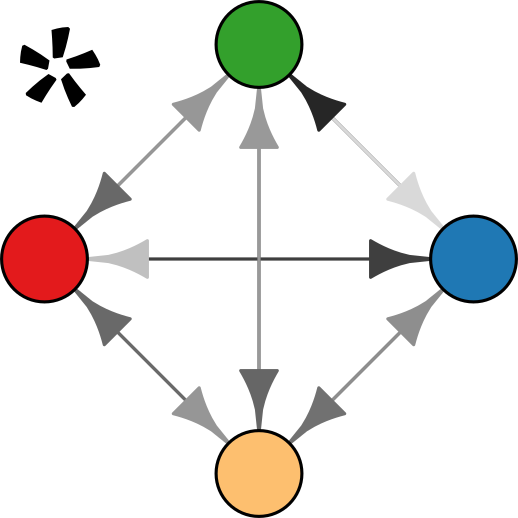
Building a Model: Example
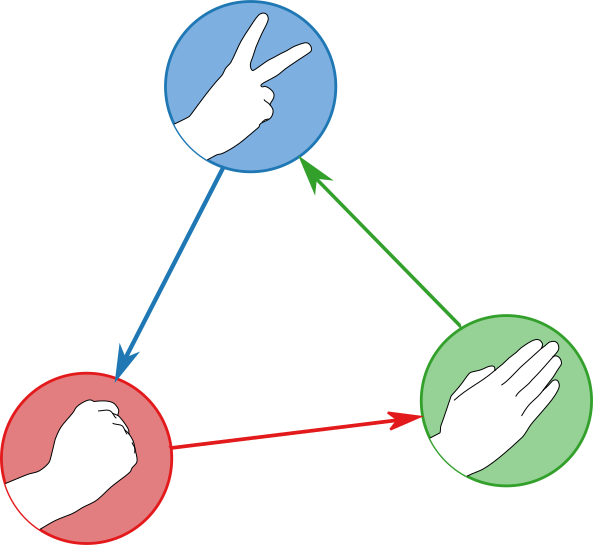



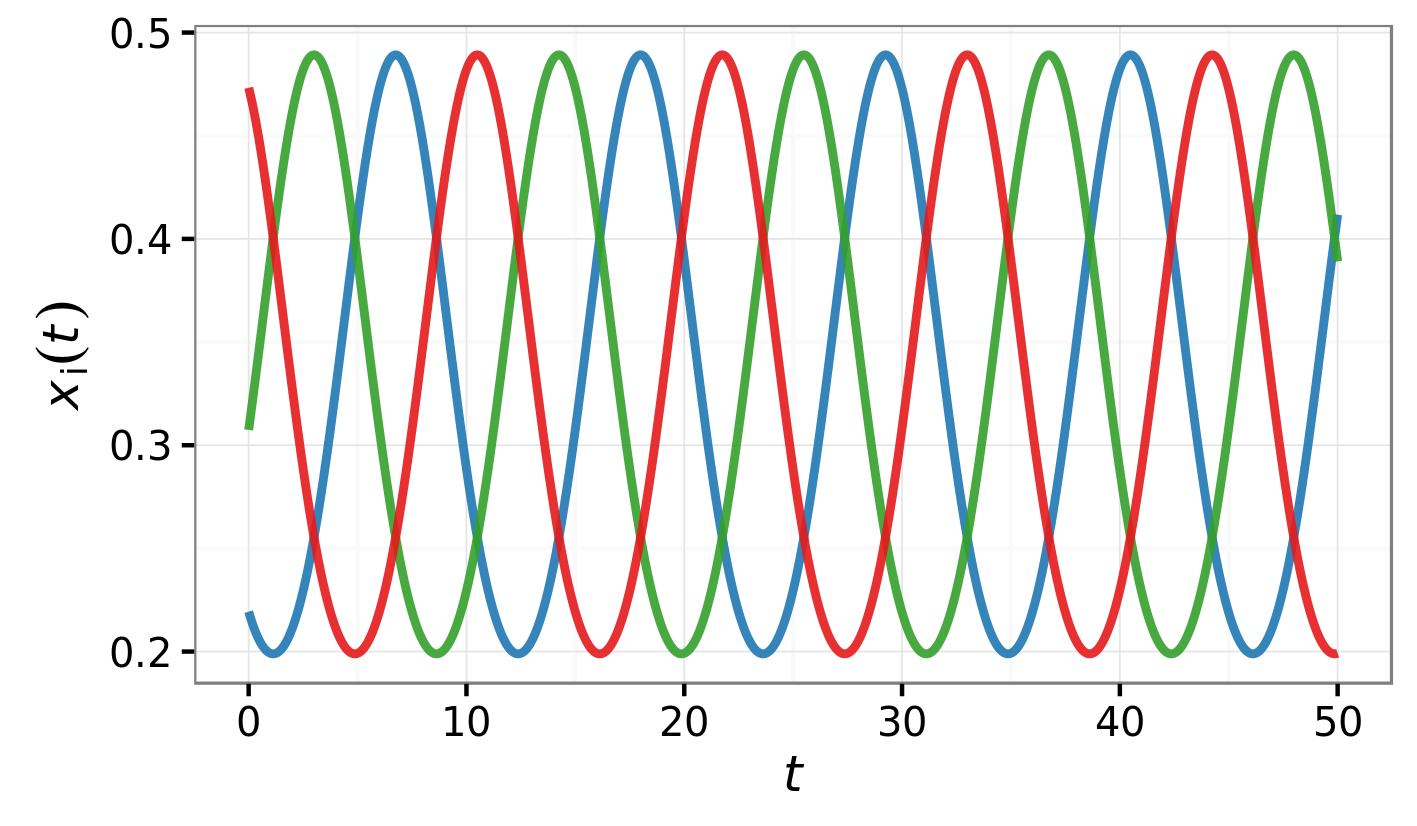
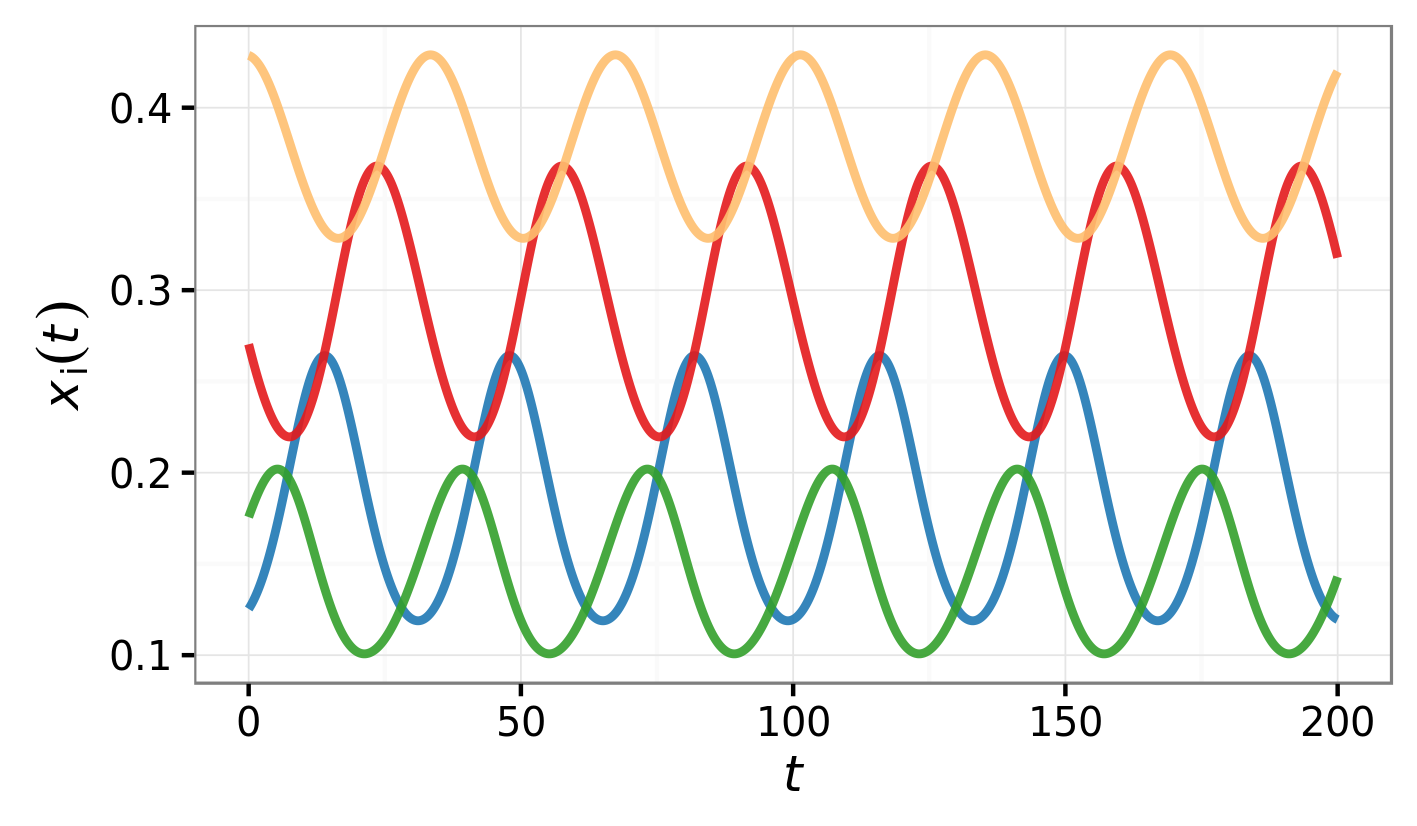
Dynamics:
Neutral Cycles
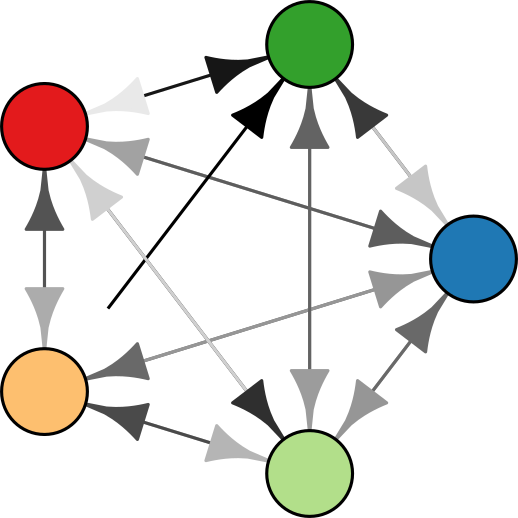
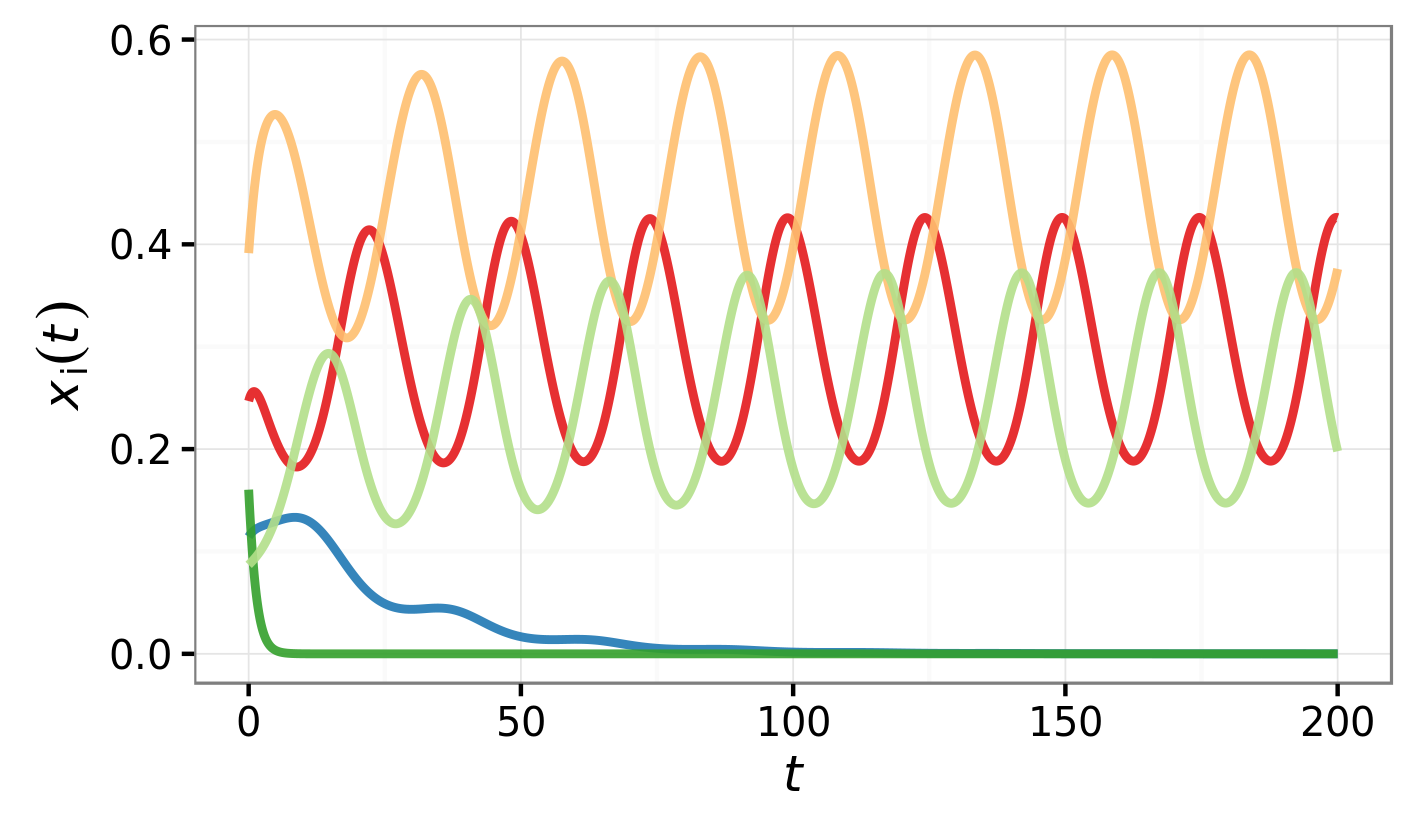
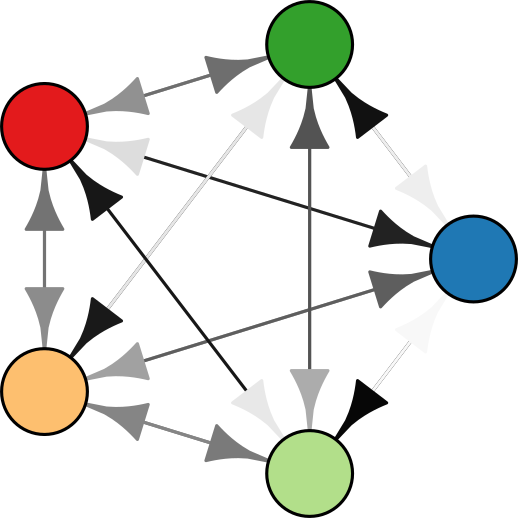
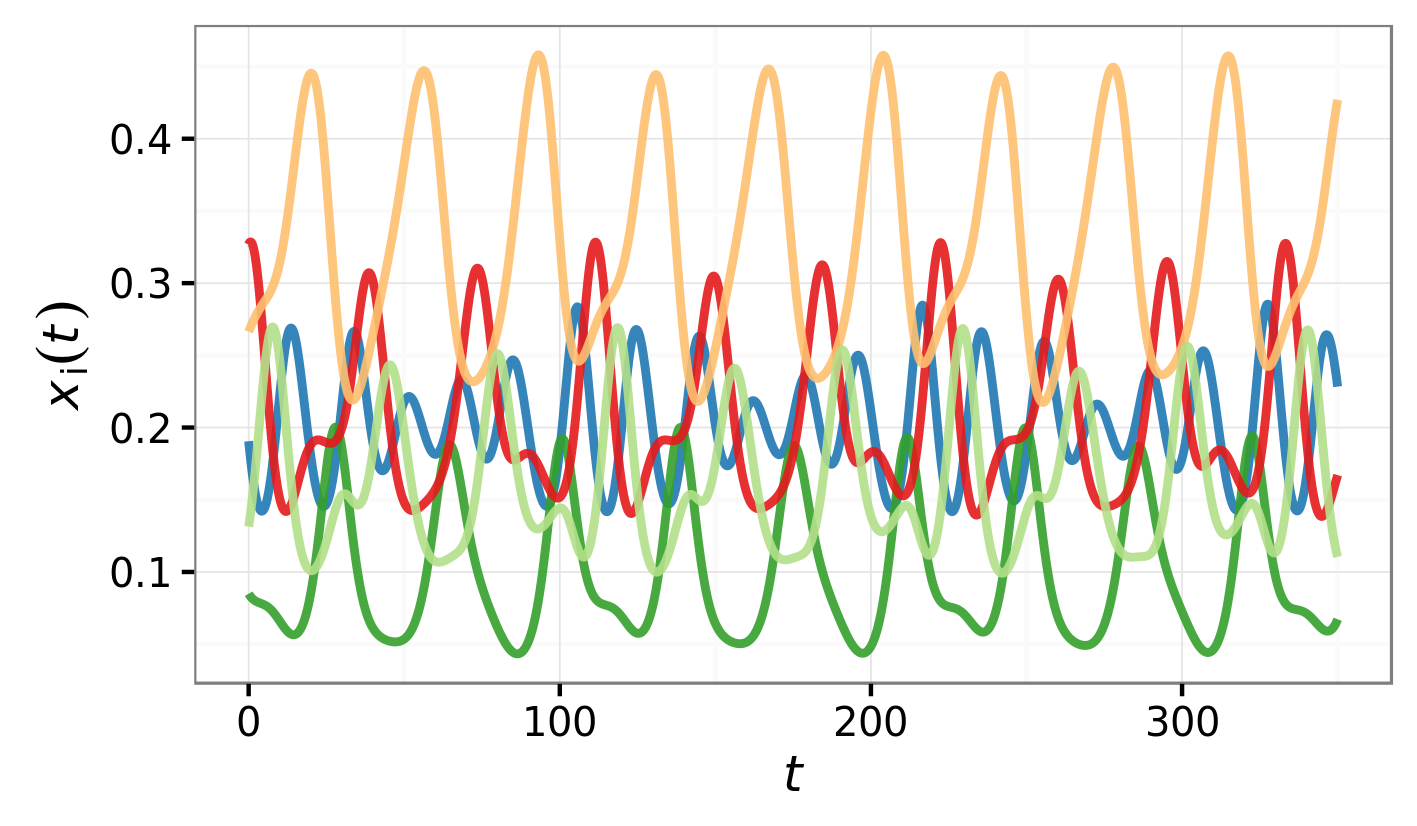
Coexistence
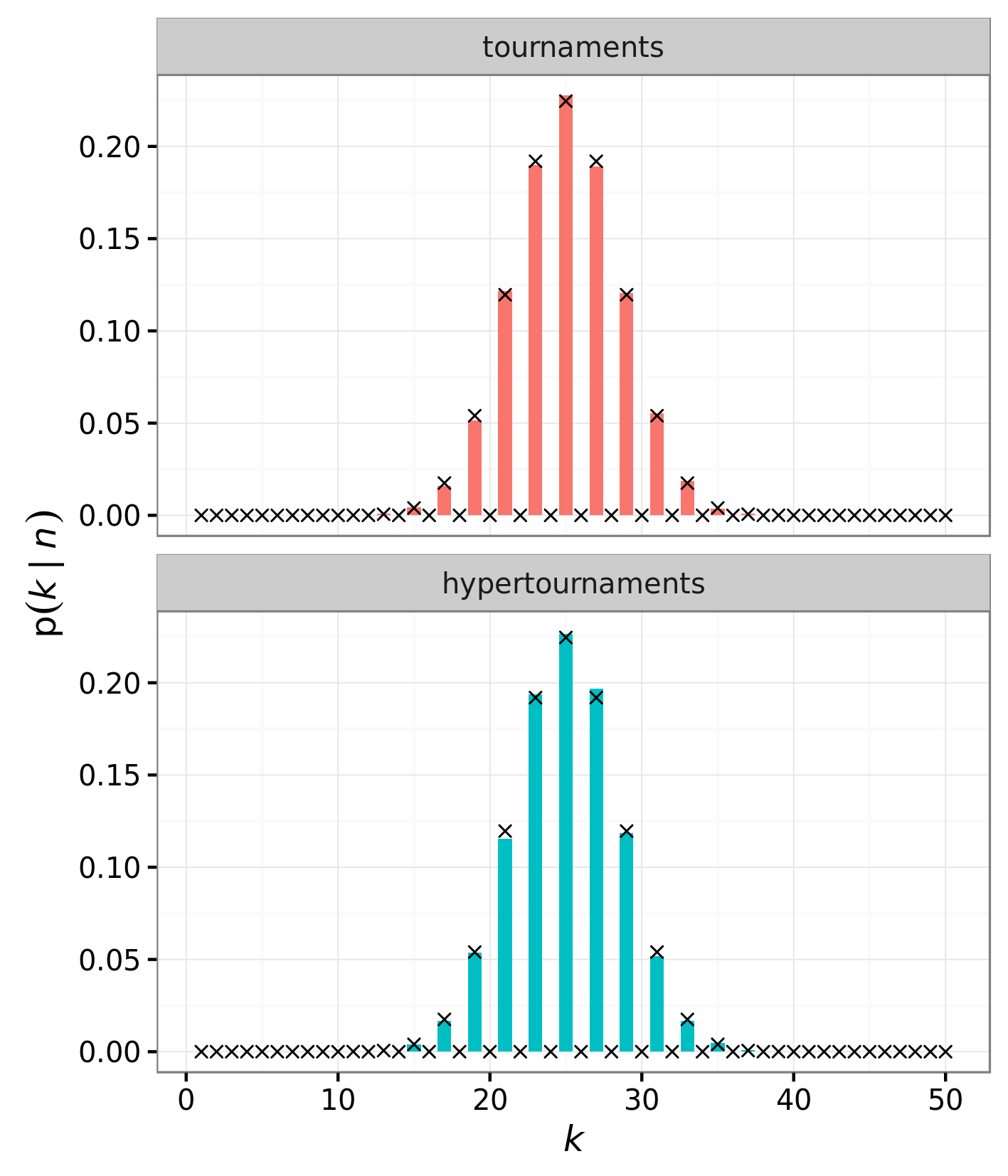
How many species do we expect to survive?
Method
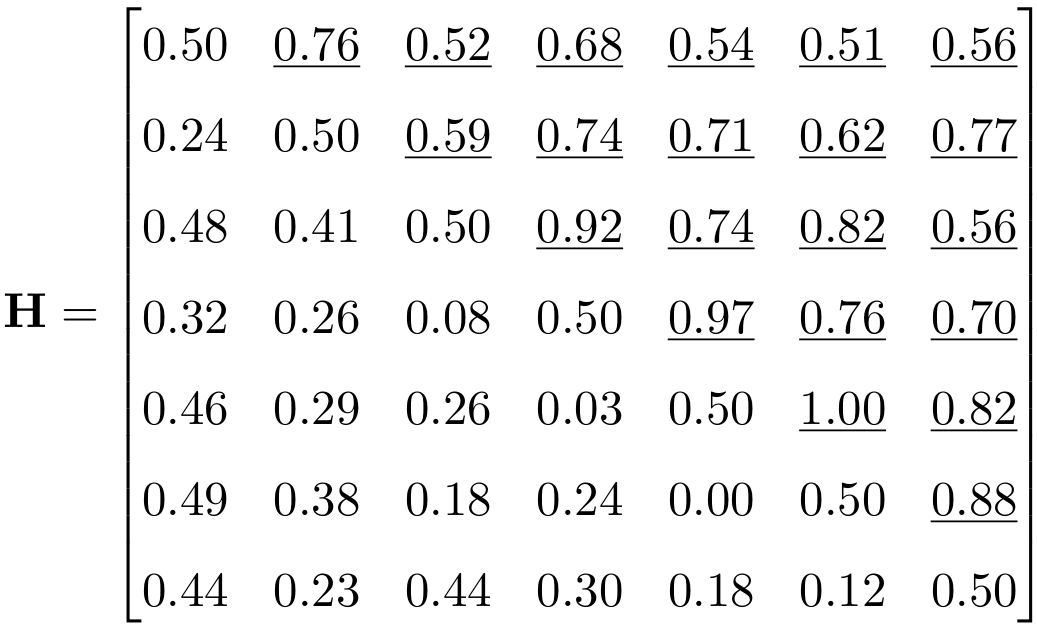
- Generate many random (hyper) tournaments of $s$ species by drawing interaction strengths($H_{ij}$) at random
- Run dynamics
- Count the $k$ survivors
- what is $\mathcal{P}(k|s)$?
$$\mathcal{P}(k|s) = \begin{cases} 0 &\text{for } k \text{ even}\\ {{s}\choose{k}} 2^{1-s} &\text{otherwise}\end{cases}$$
Result
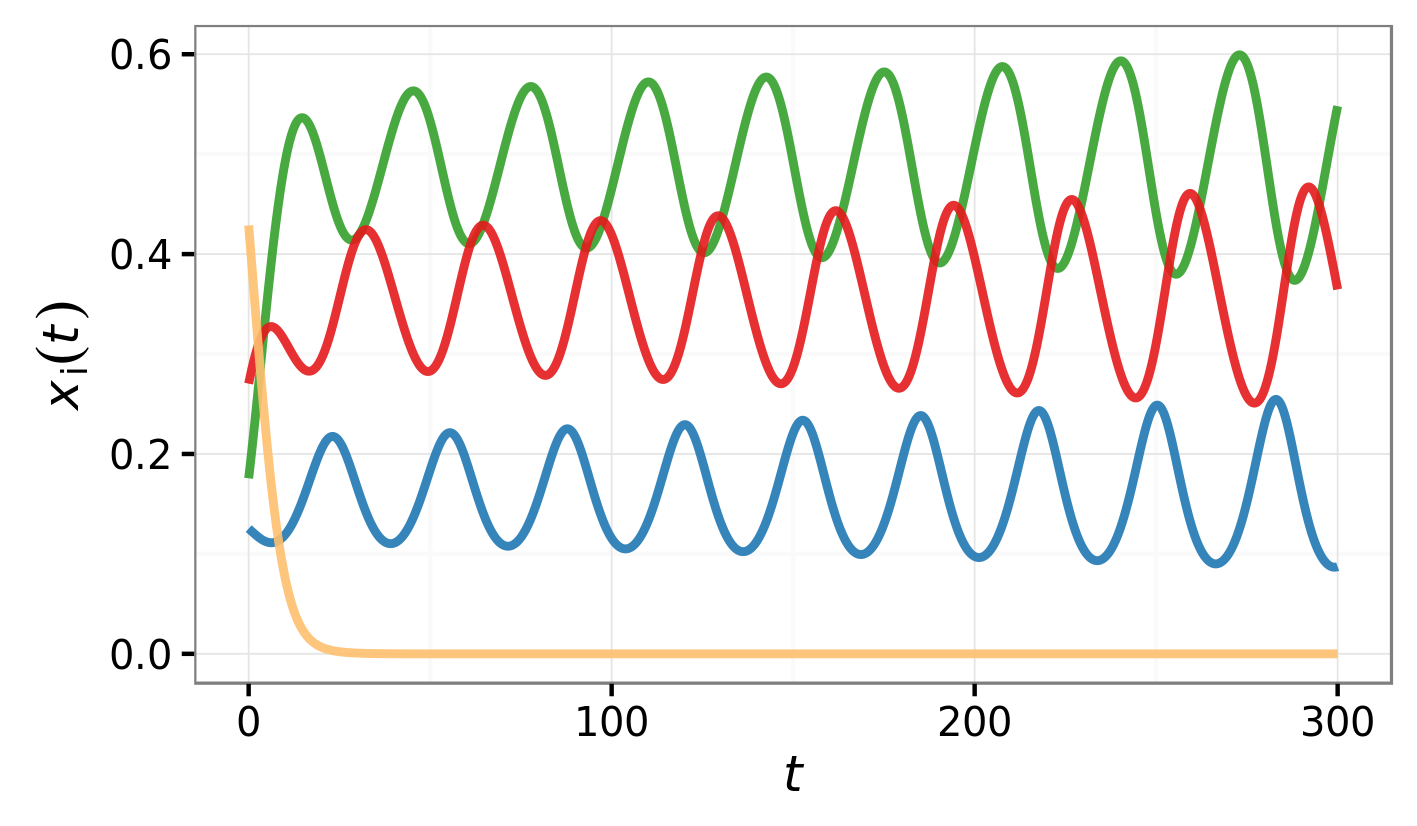
Dynamics:
Neutral Cycles
Conclusions
For any matrix $\mathbf{H}$ on $s$ species
- Irrespective of (positive) initial conditions, $k$ species will coexist and $s - k$ will go extinct
- Those that coexist, cycle neutrally around the equilibrium point $x^\ast$
- We can choose $x^\ast$ arbitrarily
For a random $\mathbf{H}$ on $s$ species
- On average, $k = s/2$
Higher-order Interactions
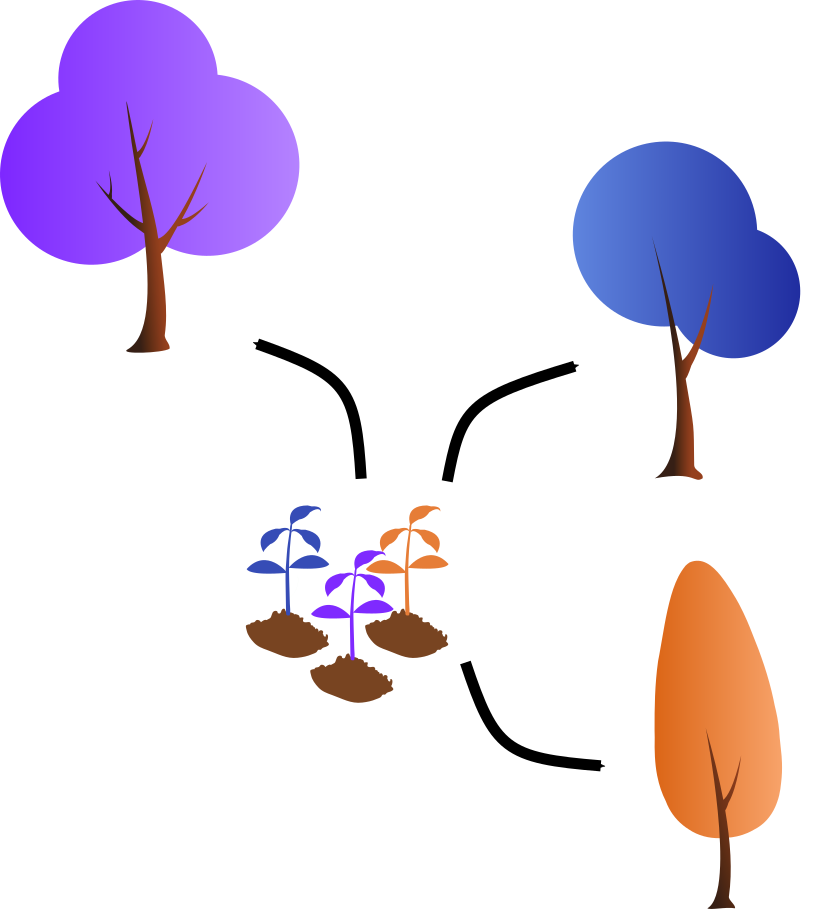
Parameterizing HOI

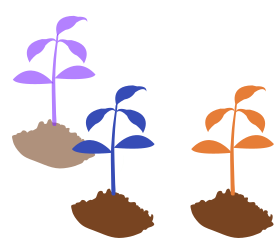
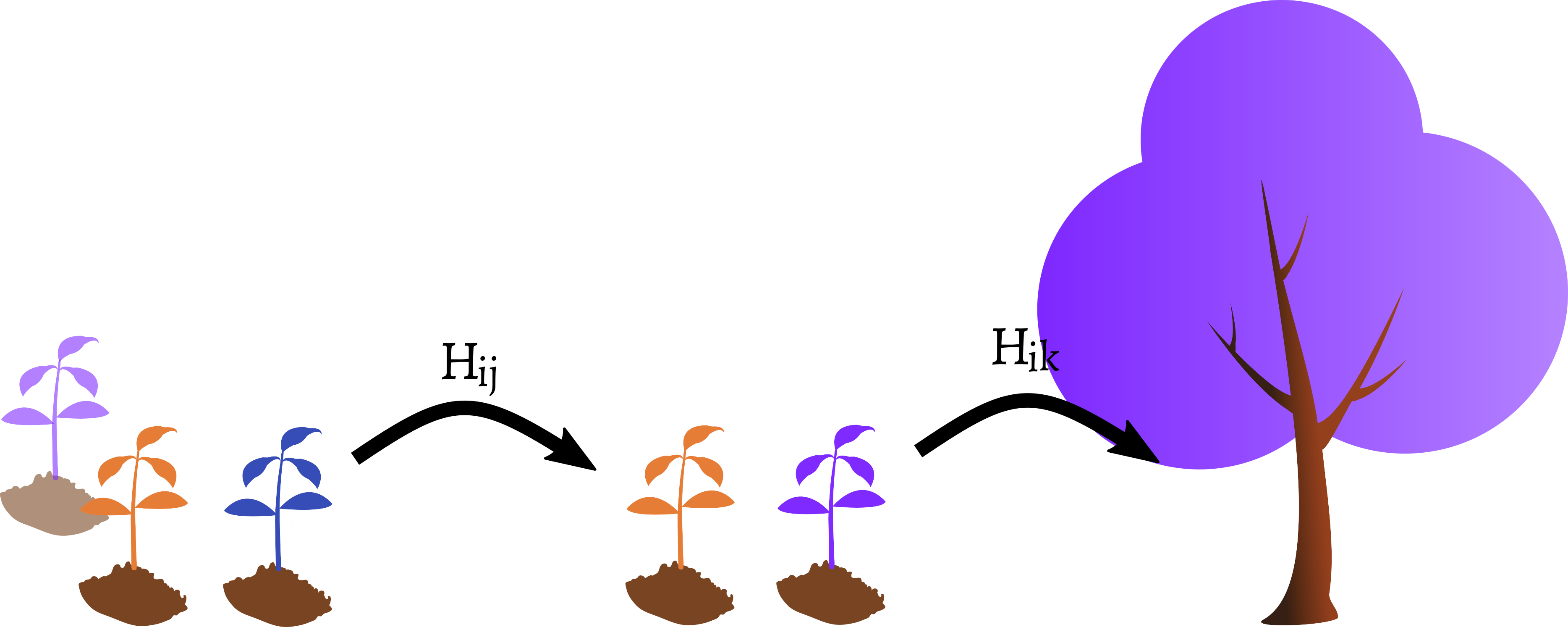
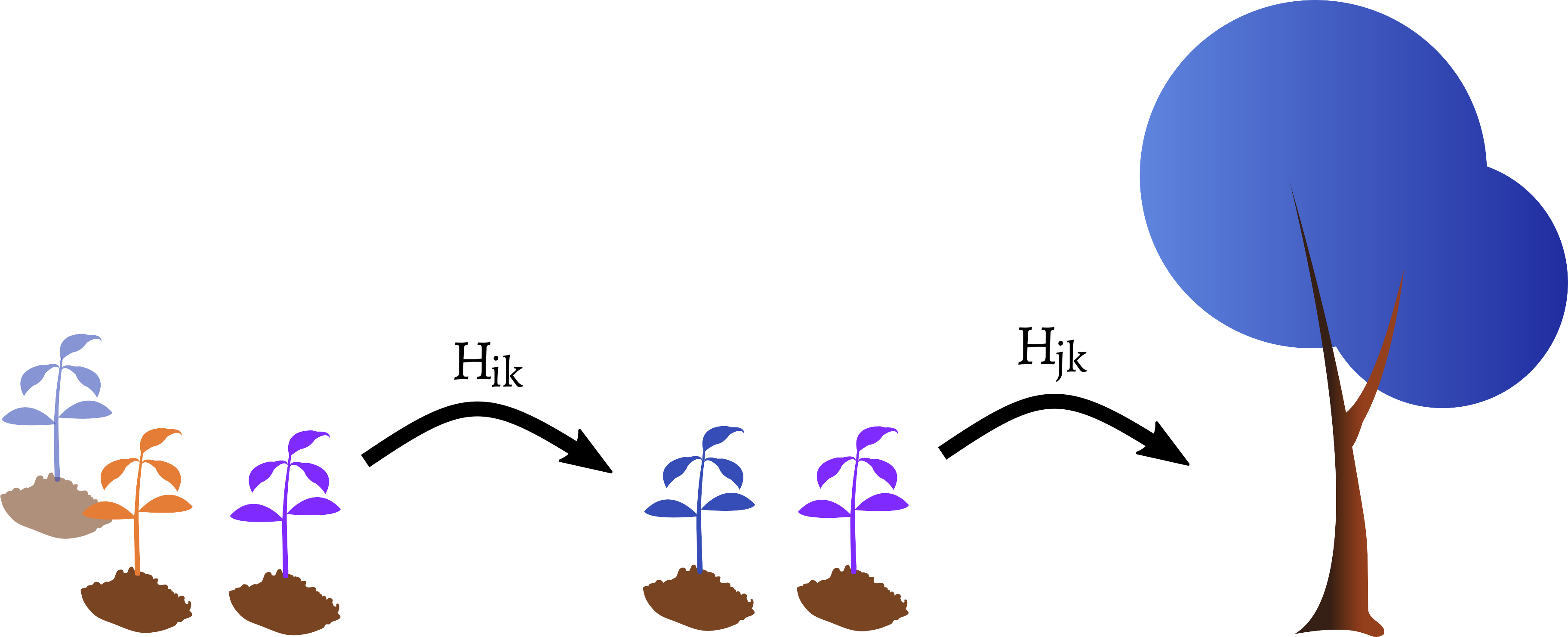
Still Consistent with Replicator Dynamics
$$\dfrac{\text{d} x_i }{\text{d} t} = \sum_j P_{ij} x_i x_j$$ $$\dfrac{\text{d} x_i }{\text{d} t} = \sum_j P_{ijk} x_i x_j x_k$$
where $\mathbf{P}$ is a tensor in which $$P_{ijk} = 2 H_{ij} H_{ik} - H_{ji} H_{jk} - H_{ki} H_{kj}$$
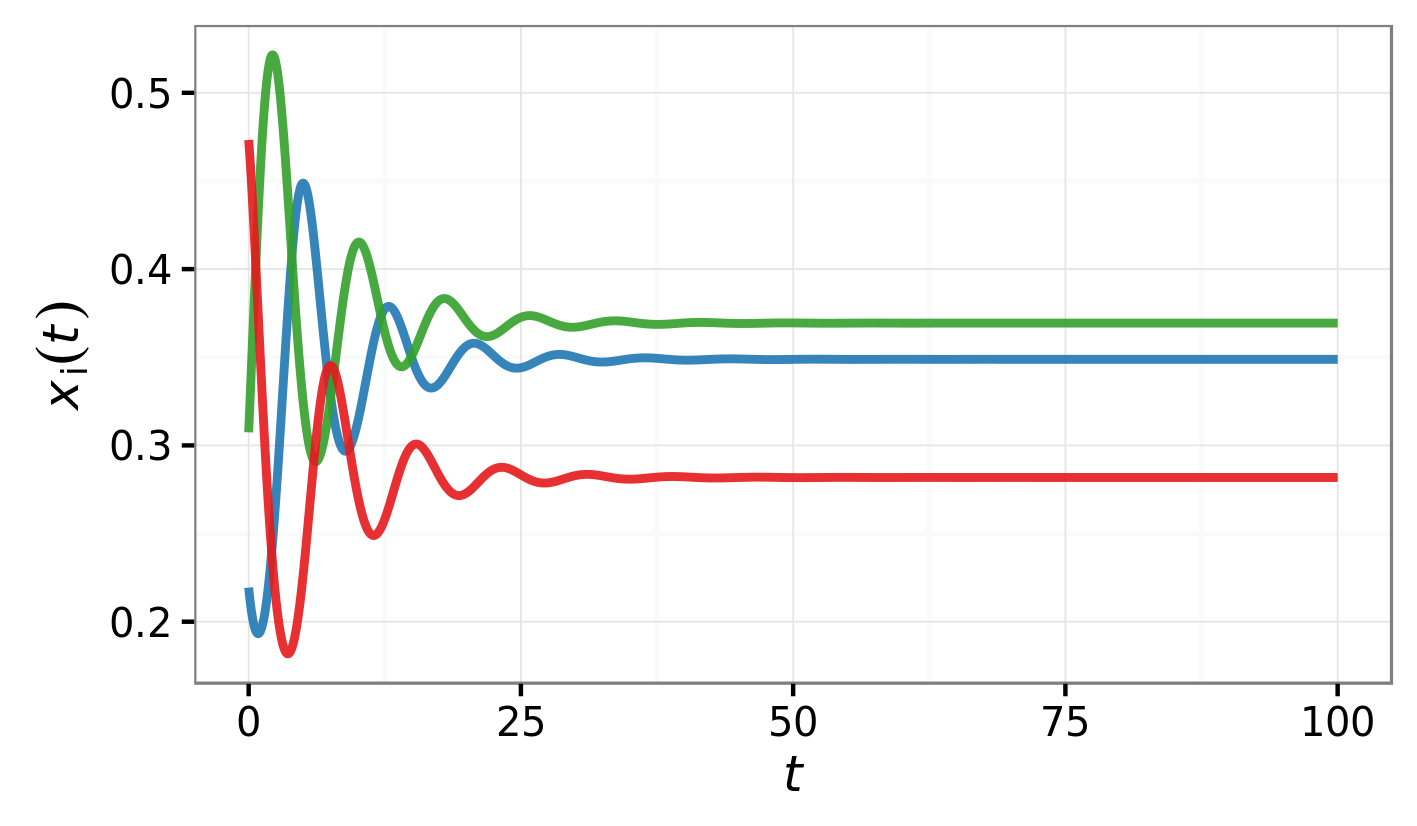
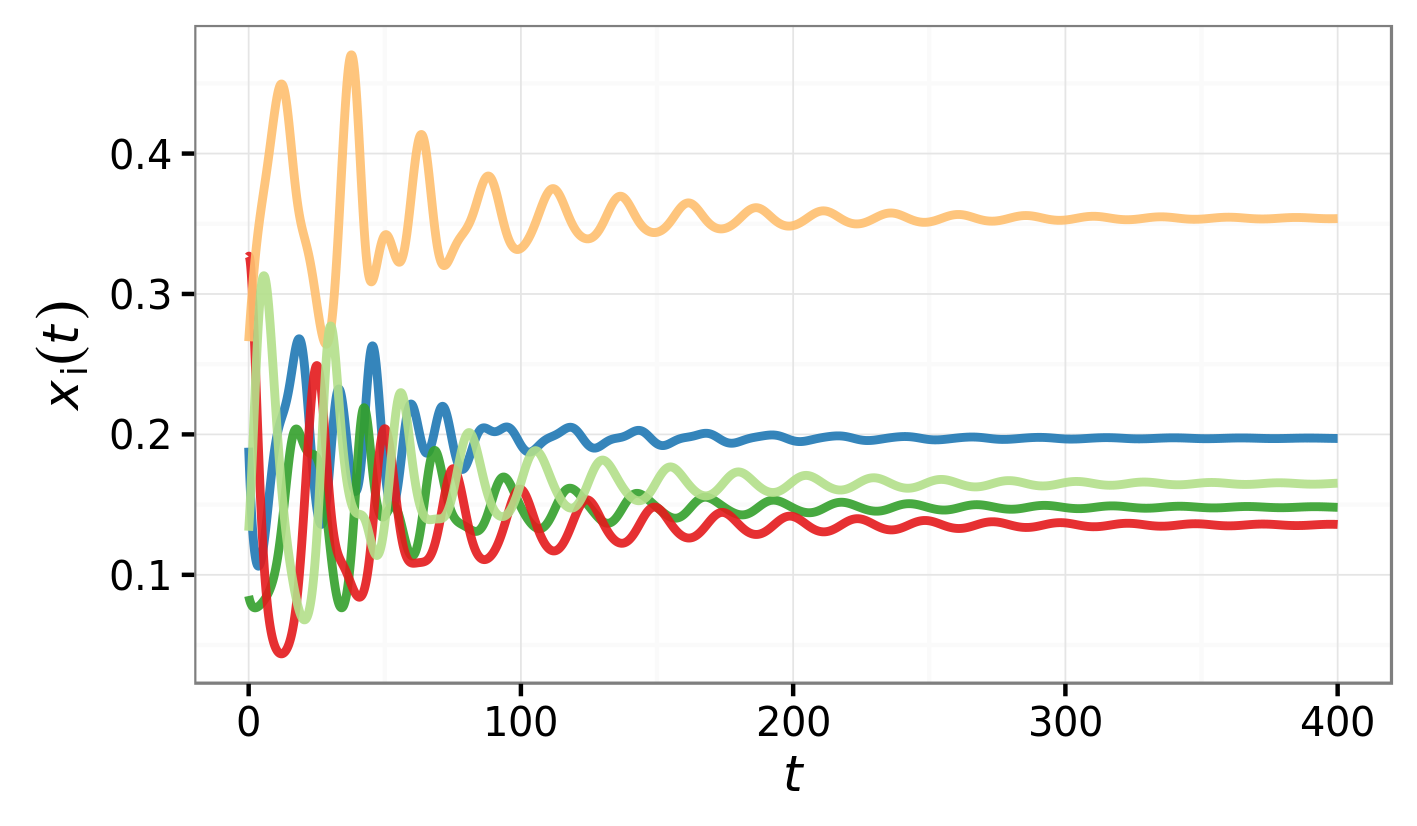
Dynamics:
Neutral Cycles
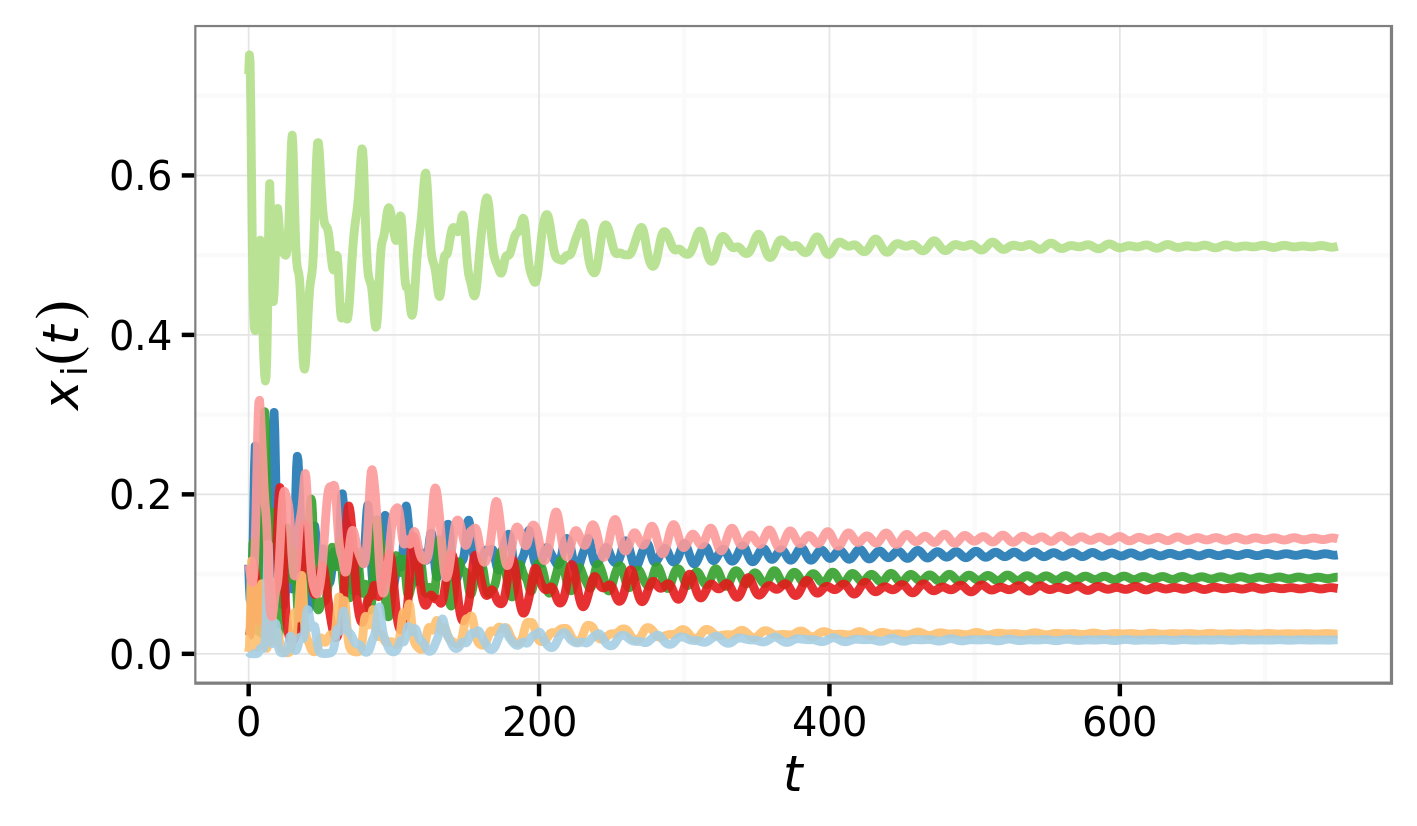
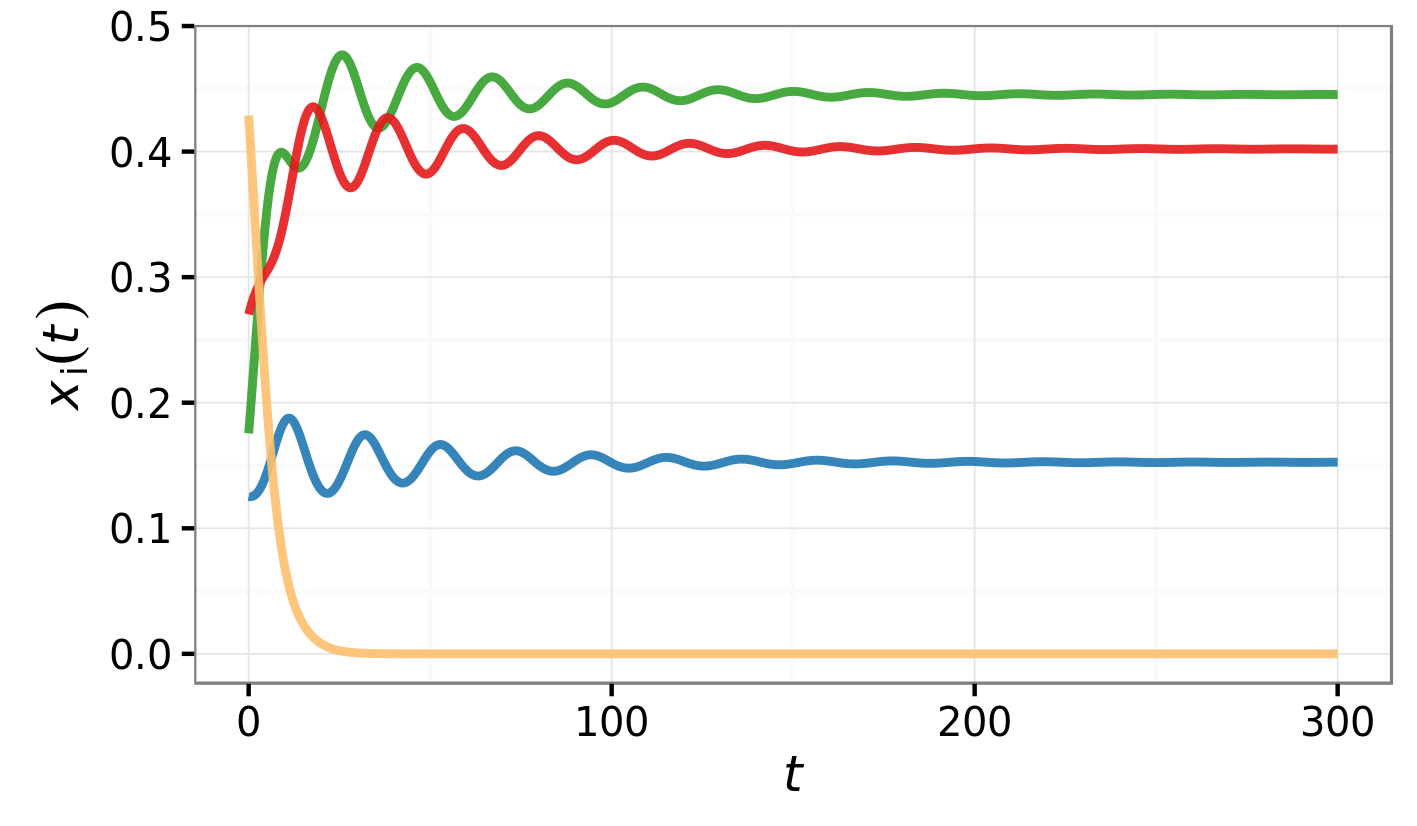
Stable Fixed Point(!)
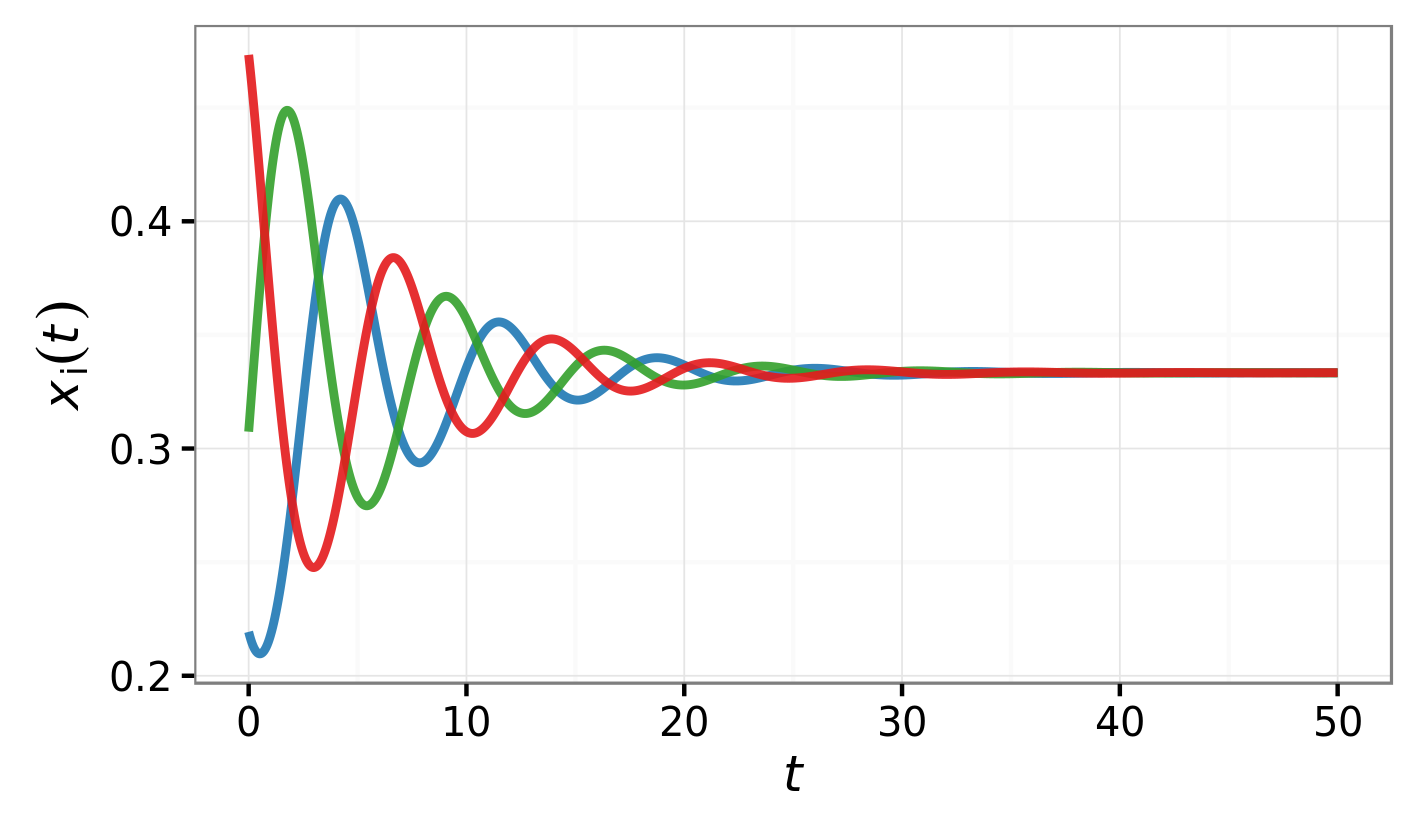
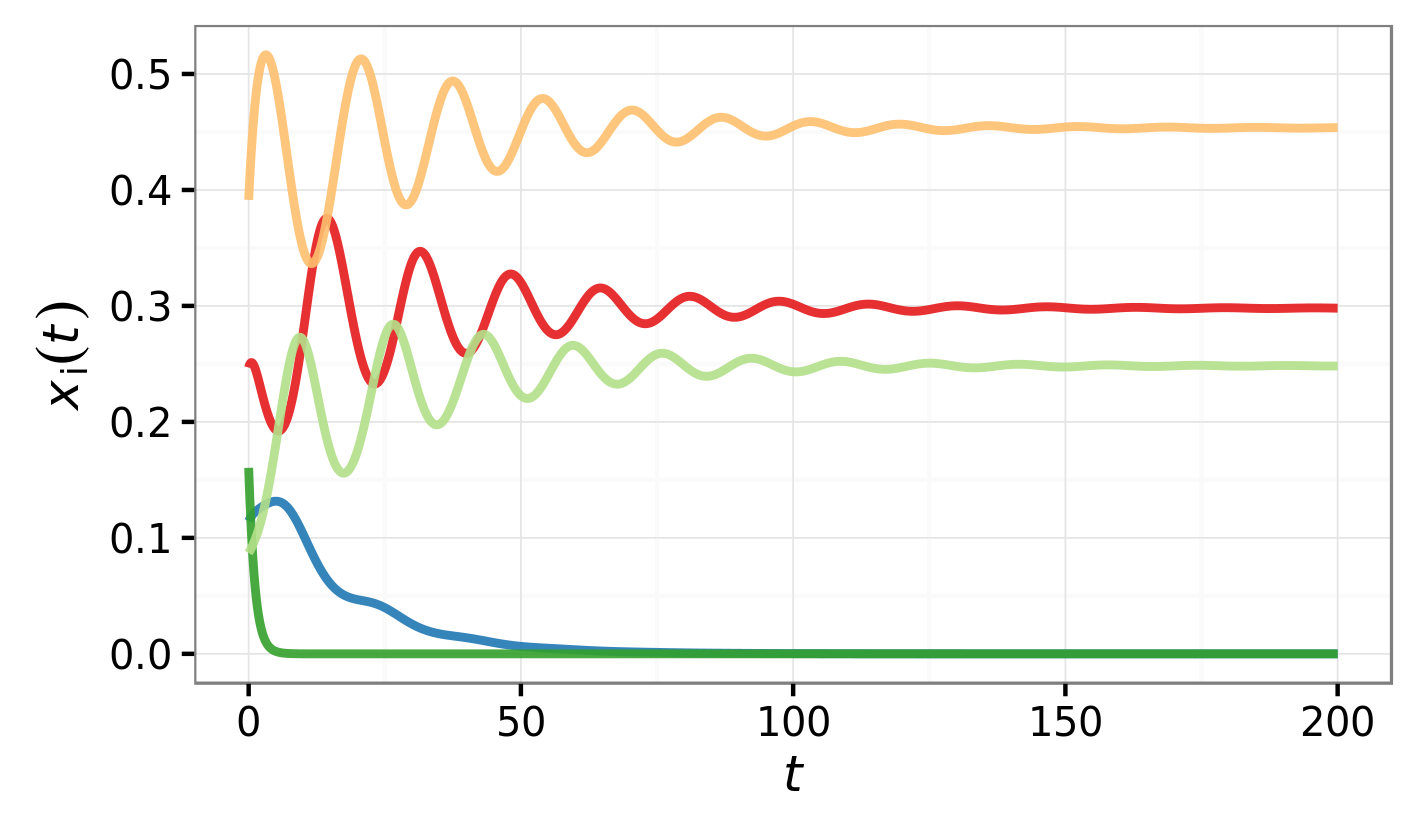
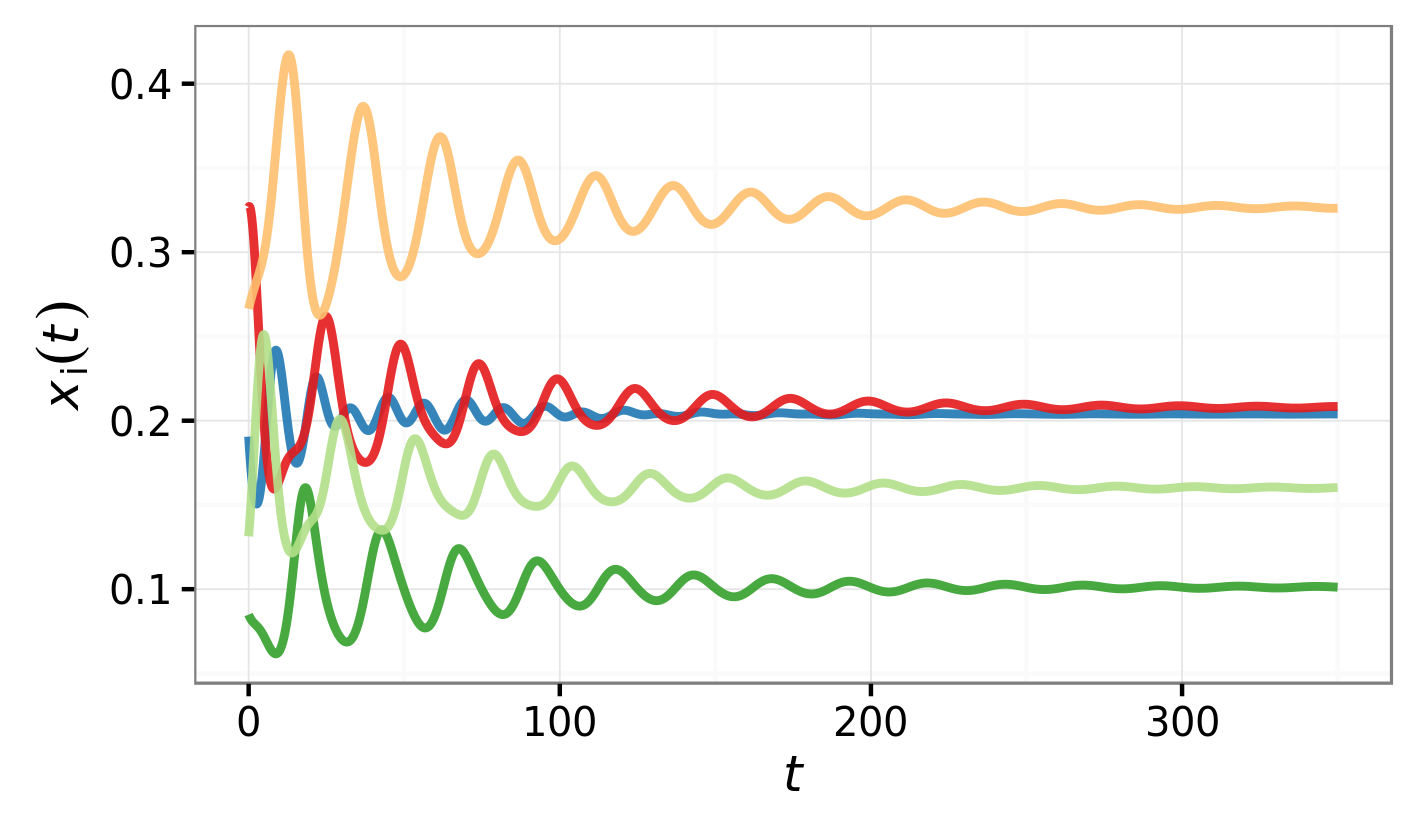
Dynamics: Stable Fixed Point (Faster!)

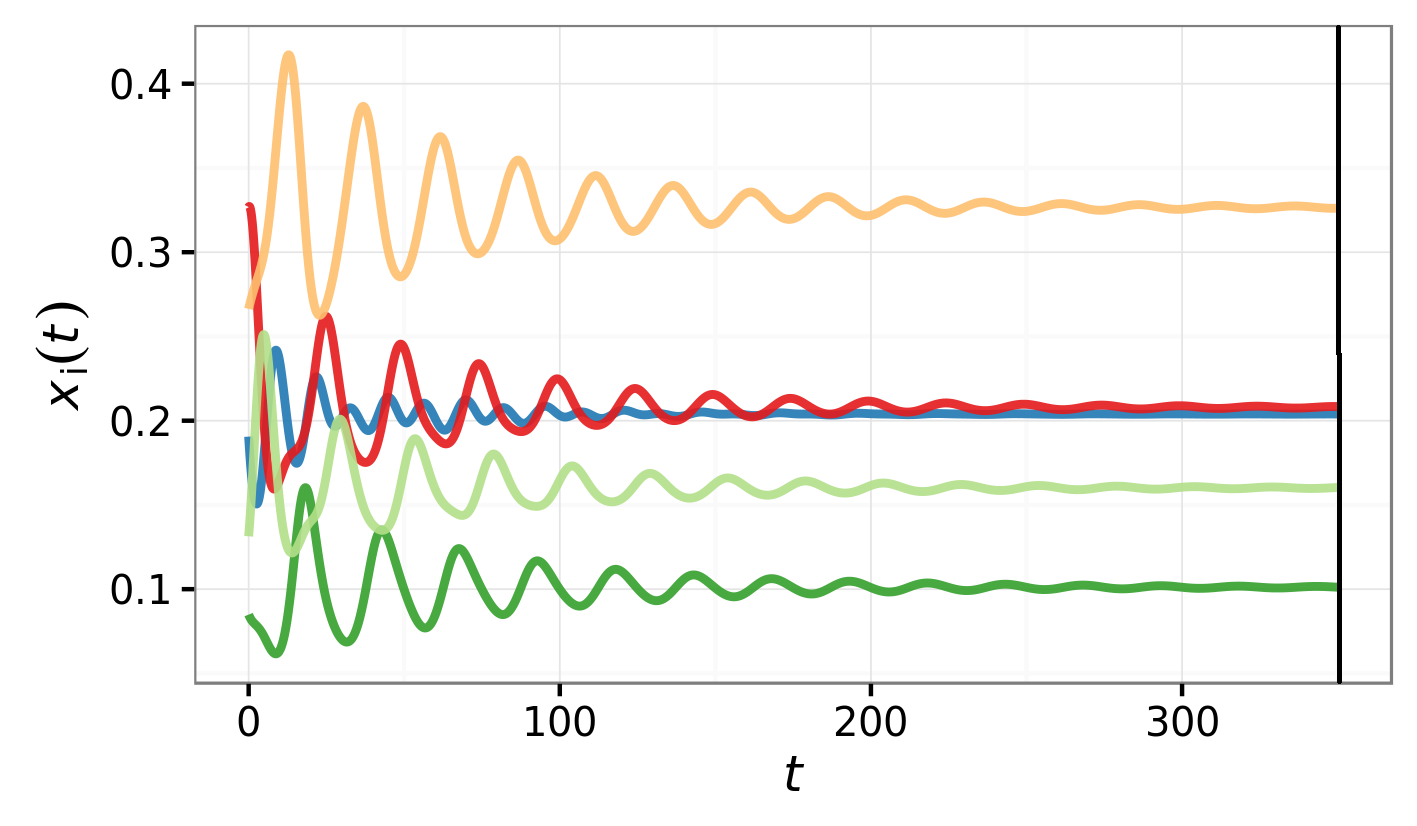

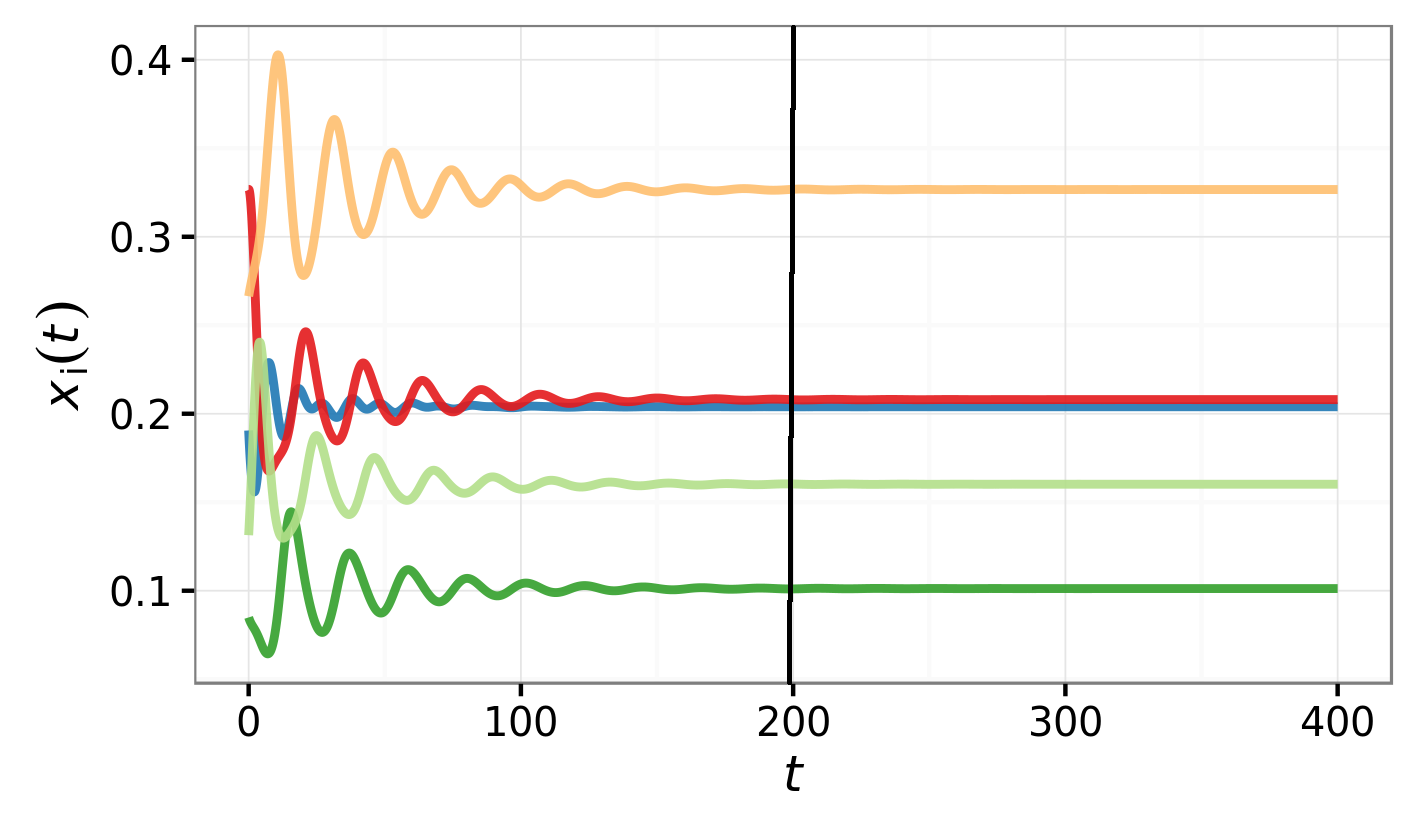

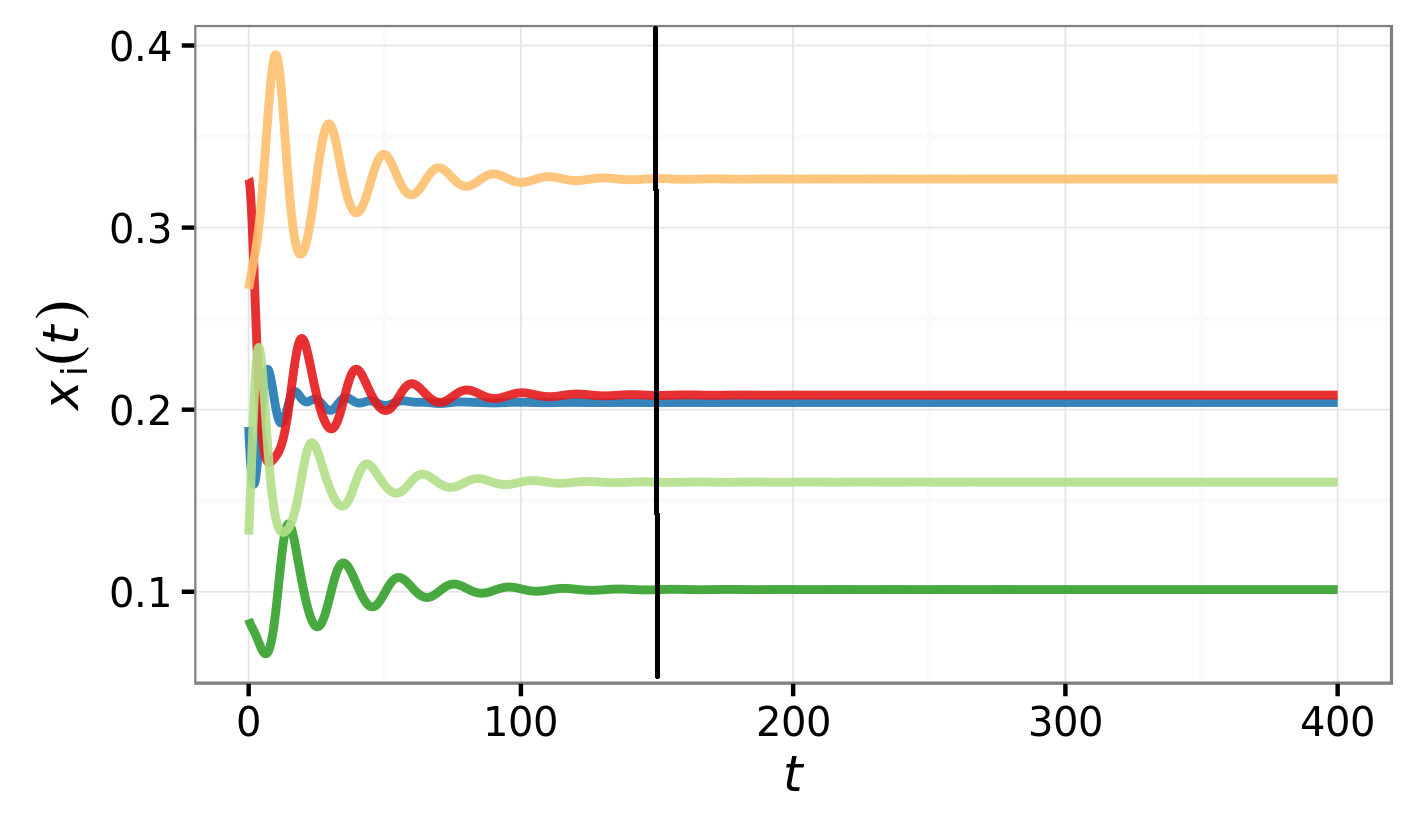
Conclusions
- The addition of higher order interactions stabilize the dynamics but do not change the equilibrium
- Higher orders of higher order interactions speed up convergence to the equilibrium
- This is all despite not adding any new information/parameters into the model!
Relation to Prior Models
- Neutral Theory of Biodiversity (Hubbell 2001)
- $$f_i = d_i = 1 \text{, } H_{ij} = H_{ji} = 0.5$$
- Competitive Tournaments (Allesina & Levine 2011)
- $$f_i = d_i = 1 \text{, } (H_{ij}, H_{ji}) = \begin{cases} (1,0)& \text{w.p. } 0.5\\ (0,1) & \text{otherwise} \end{cases}$$
- Competitive Hypertournaments
- $$f_i = d_i = 1 \text{, } \text{any nonnegative } (H_{ij}, H_{ji}): H_{ij} + H_{ji} = 1$$
- General Model
- $$\text{any nonnegative } f_i, d_i, (H_{ij}, H_{ji}): H_{ij} + H_{ji} = 1$$
Different Physiological Rates
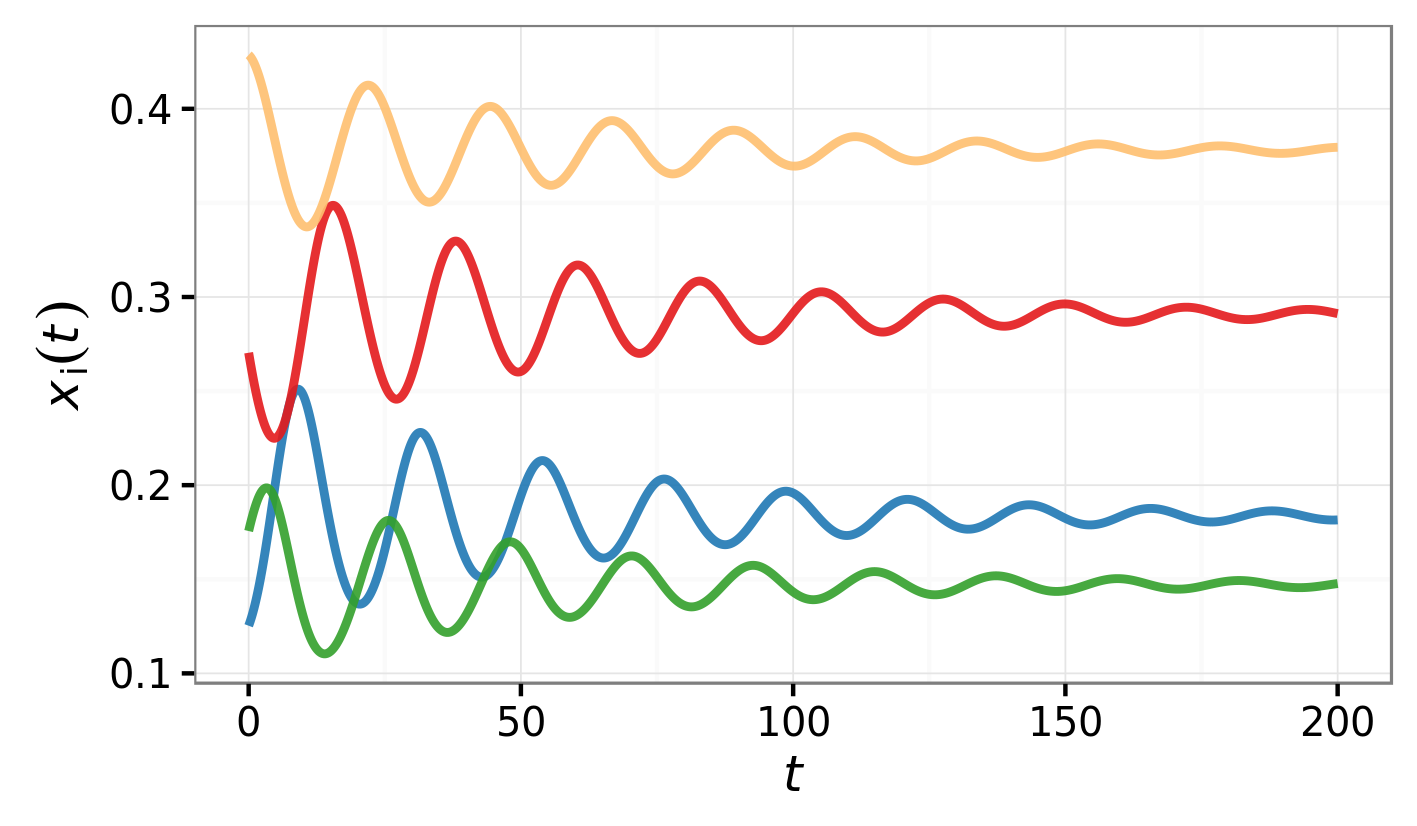
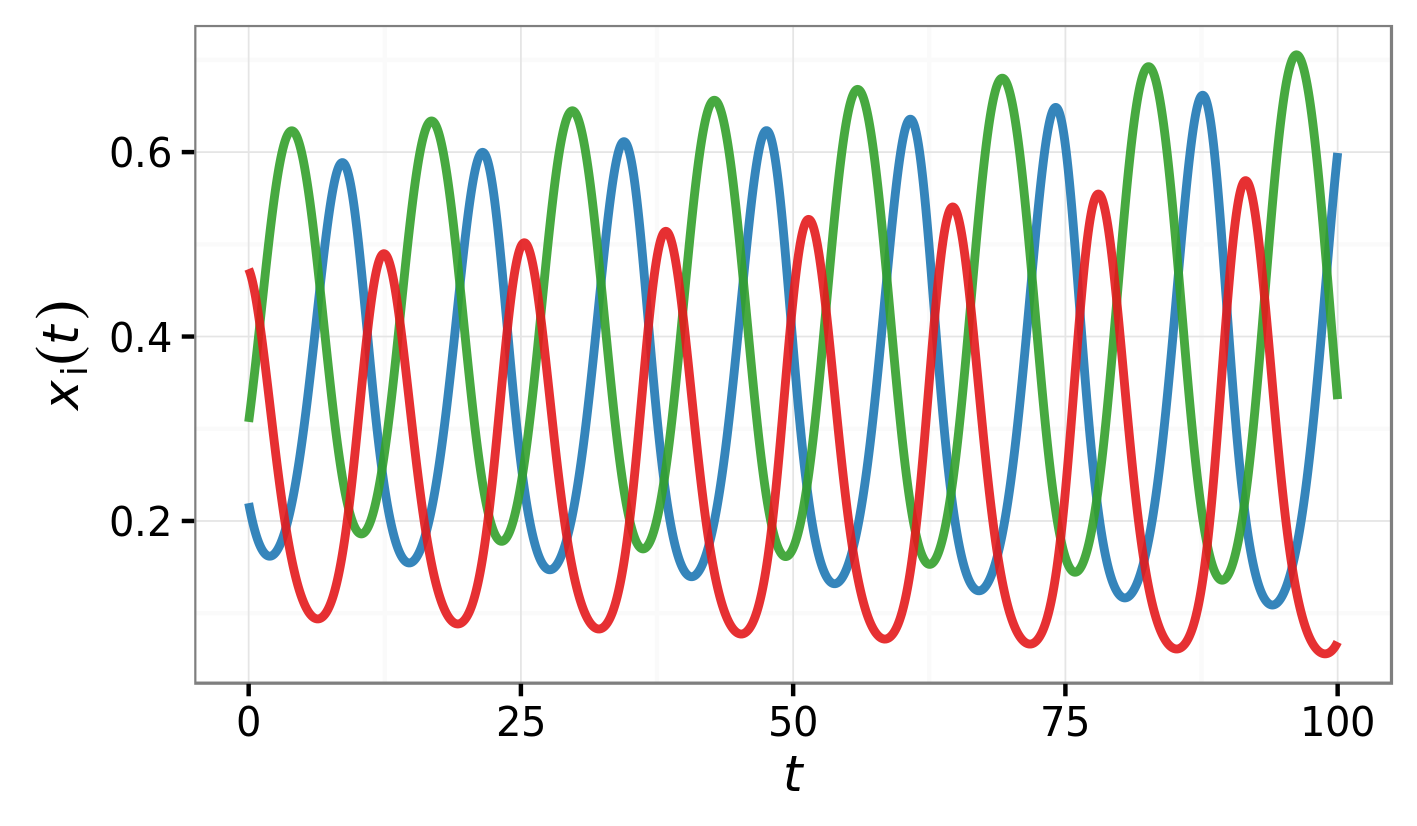
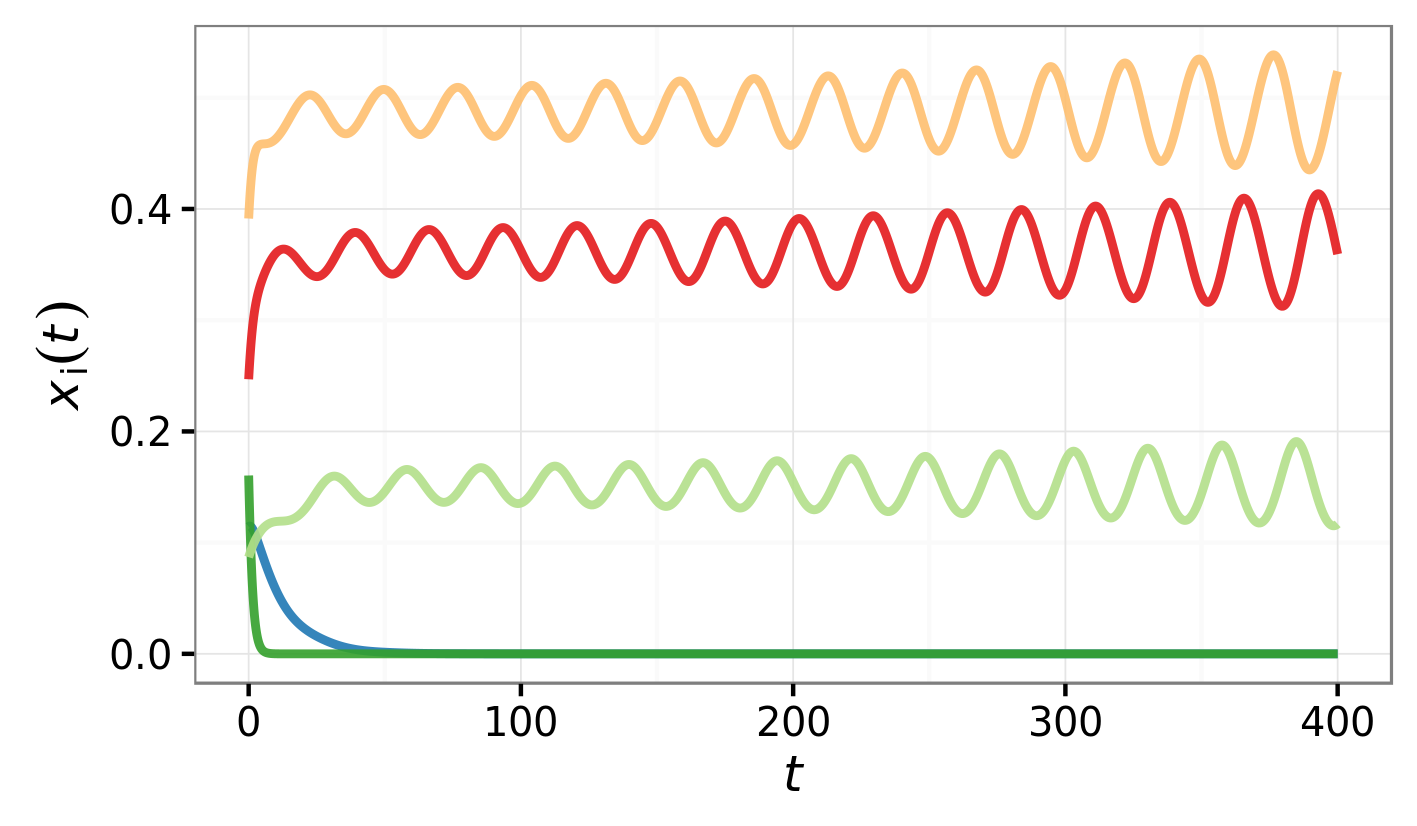
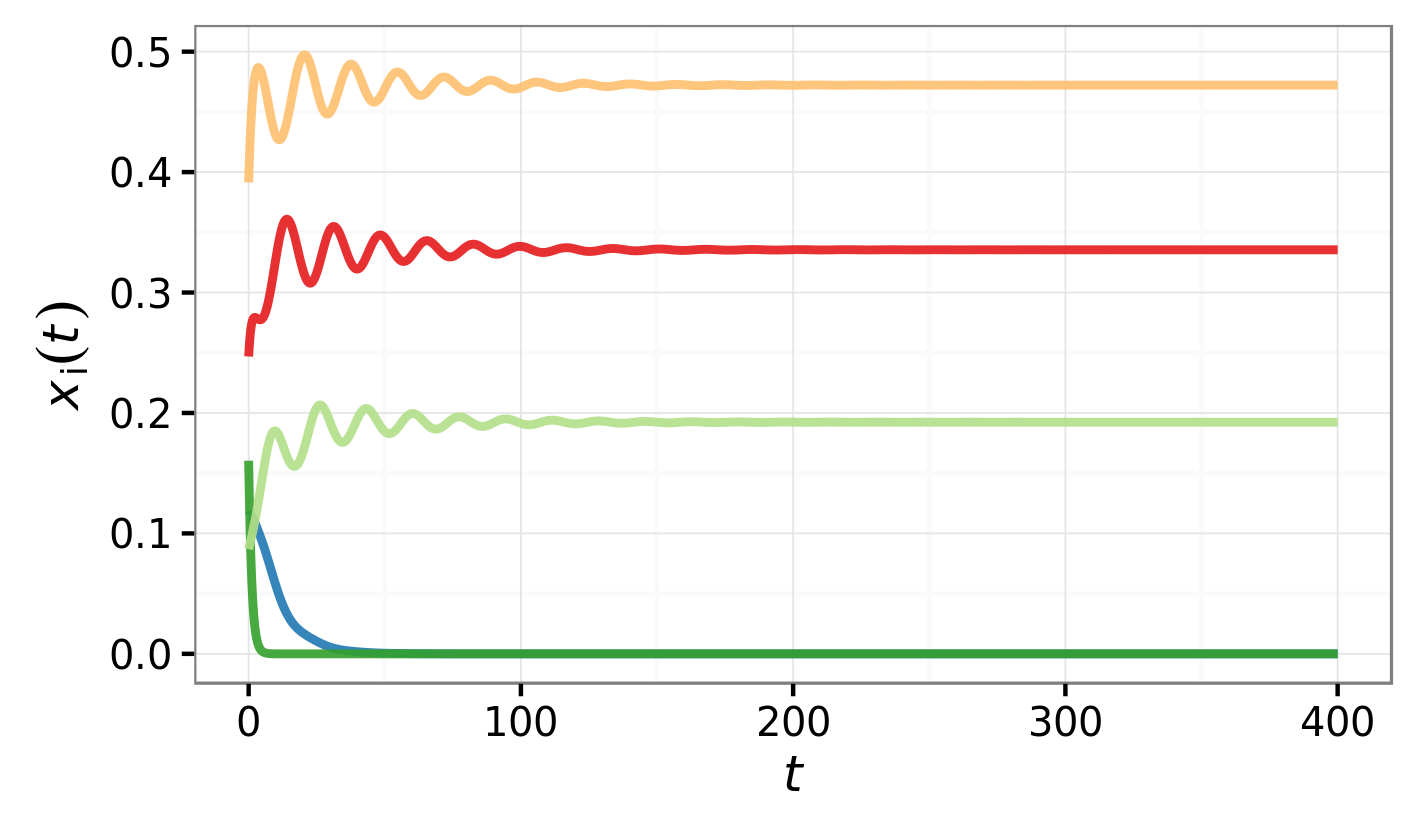
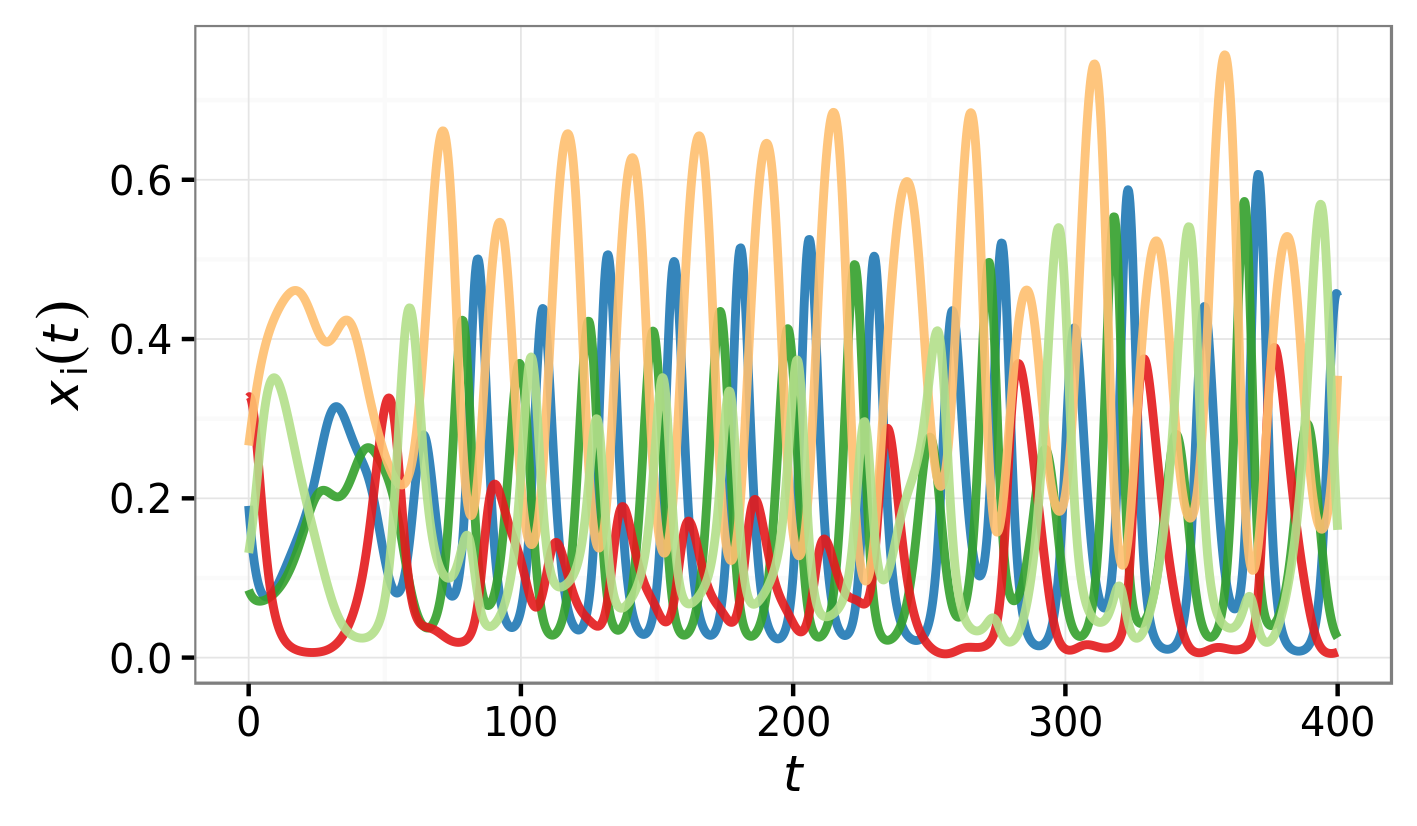
What happens when these rates are allowed to vary?
Dynamics:
Unstable Cycles
Stable Fixed Point
Conclusions
- This theory relies on higher-order interactions
- Leads to the stable coexistence of an arbitrary number of species
- Can produce any species abundance distribution
- Is robust to changes in parameters
- More experimentally tractable due to parameterization of HOI as direct consequence of pairwise interactions
- Such interactions chains can arise in nature due to differing scales of space or time
Questions?
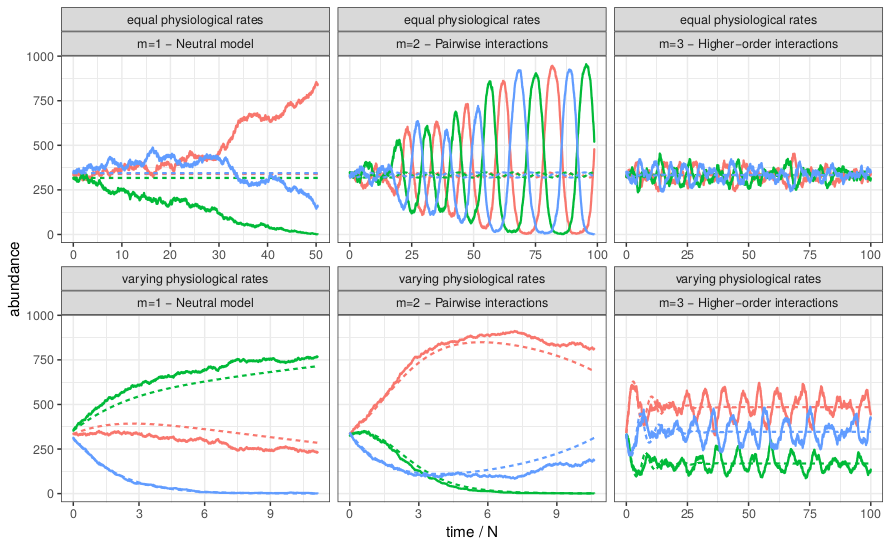
Introducing Stochasticity
Transitivity